Problem Description
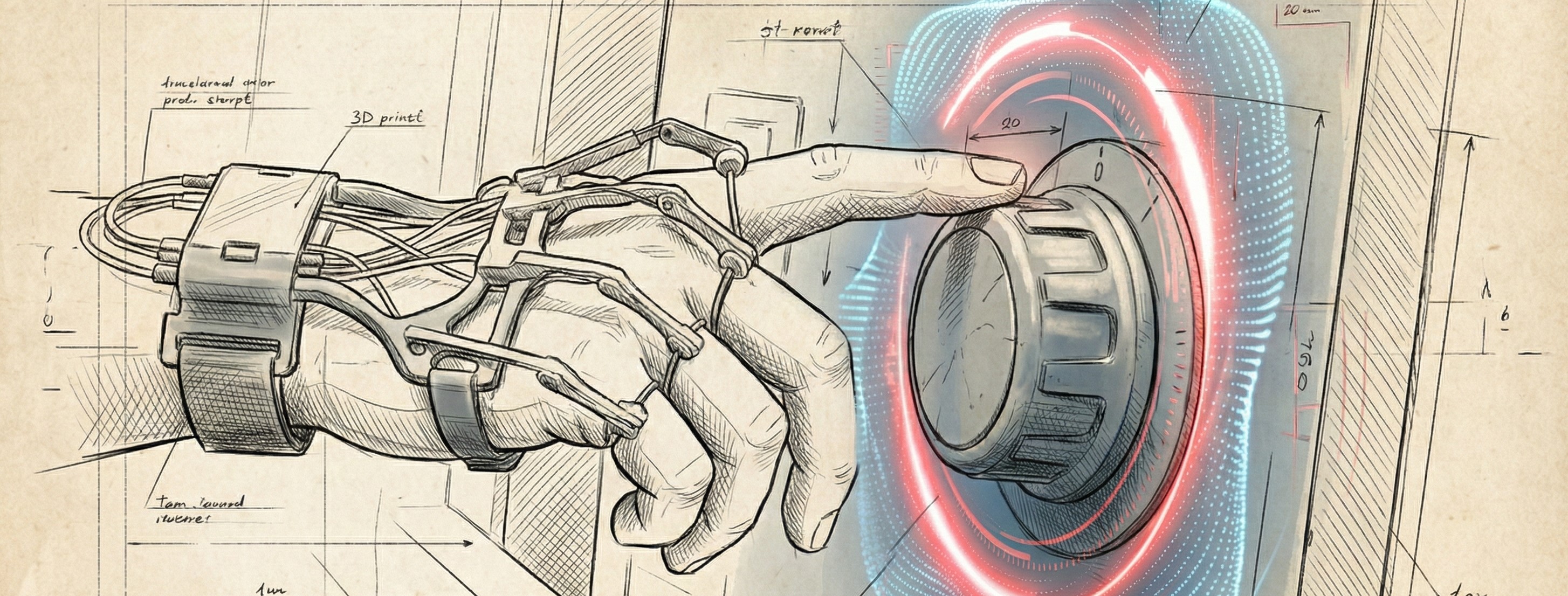
In industrial environments (production, maintenance, remote control), visual attention is often saturated. Haptic Augmented Reality (HAR) offers a solution to optimize the flow of information by selectively modulating the perceived physical properties of real objects (e.g., machine controls, tools). In contrast to purely virtual environments (VR), contact with the physical object is maintained in HAR. The goal is to augment ‘dumb’ legacy hardware with intelligent wearables so that it delivers context-dependent feedback.
Project Definition
Participants identify an industrial use case (e.g., error prevention through kinesthetic constraints, training through haptic guidance, or status display through cutaneous cues). Then, they develop and evaluate hardware prototypes that augment industrial interactions through haptic feedback. In doing so, the entire cycle from requirements analysis to evaluation is covered. The evaluation is technology-agnostic: It investigates whether the selected modality improves task performance (e.g., time, error rate) or the Quality of Experience (QoE).
A particular focus is placed on the differentiated selection and implementation of the appropriate feedback modality:
-
Cutaneous Feedback (Tactile): Addressing the mechanoreceptors in the skin (e.g., through vibration, EMS, skin stretch, or thermal stimuli). Field of application: Texture simulation or directional cues.
-
Kinesthetic Feedback (Proprioceptive): Addressing the receptors in muscles and joints through force feedback. Field of application: Simulation of weight, resistance, physical barriers, or movement guidance.
-
Symbolic Feedback (Abstract): Encoding of state information (e.g., warnings, system status) through learnable haptic patterns (Tactons) that must be cognitively decoded.
Learning Outcome
Participants understand the theoretical distinction of Haptic Augmented Reality (HAR) from VR as well as the differentiation between different feedback types and their areas of application. They acquire and deepen the ability to develop functional wearable hardware by selecting and combining sensors and actuators suitable for the use case.
Participants learn to translate abstract data into intuitive haptic signals in order to digitally upgrade “dumb” industrial objects (legacy interfaces). Finally, they master the methodological tools for validation. They can empirically evaluate their prototypes using appropriate tests and standardized metrics (e.g., NASA-TLX, error rates) to demonstrate the actual added value of haptic augmentation.
Participation Requirements
Specific prior knowledge of electronics is not required for this module. Instead, a fundamental interest in Physical Computing and the design of physical interfaces is essential. Participants are expected to be willing to familiarize themselves experimentally with hardware prototyping and to creatively explore haptic feedback methods. Fundamental requirements also include curiosity about human perception and the motivation to translate theoretical HCI concepts into functional wearables.
External Partner
Potentially member companies of the InnoHub